Before James Barry married Bell, there was Barbara.
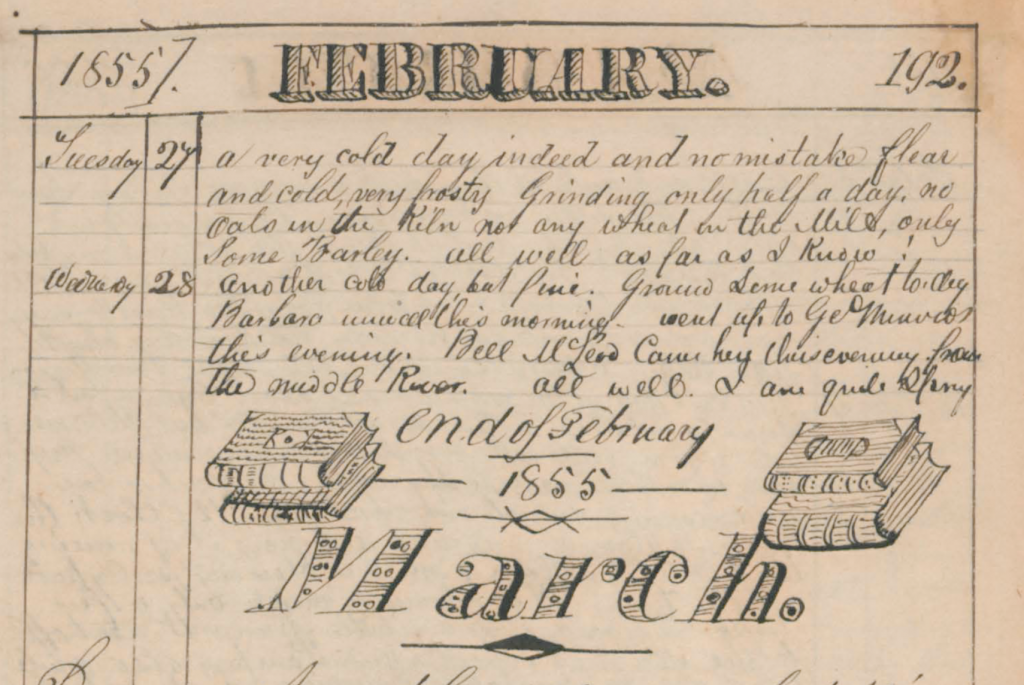
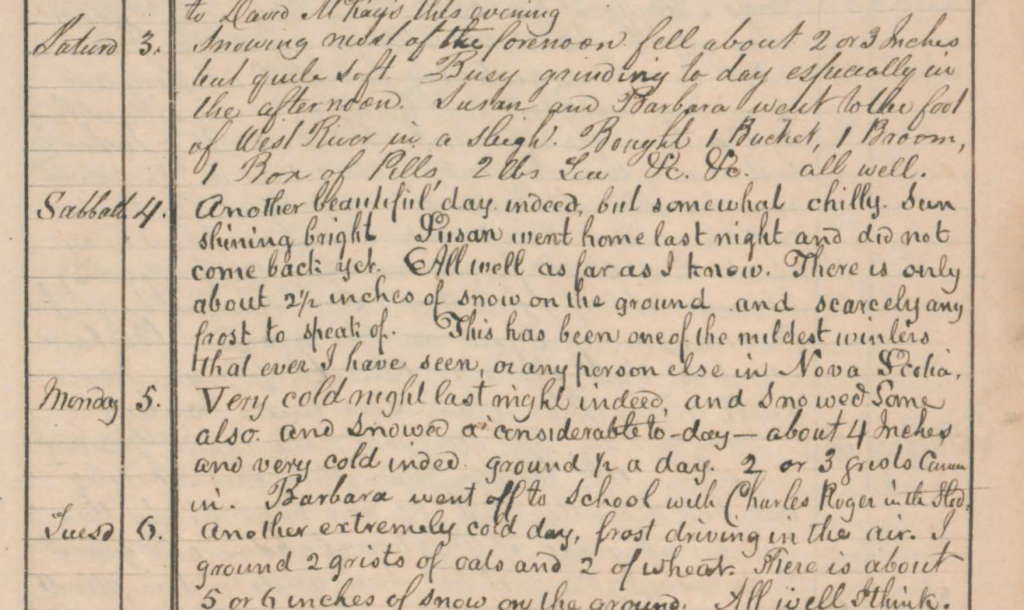
From 1848 until the winter of 1857, Barbara McKenzie was the most important woman in James Barry’s life. They were never romantically involved. She was his housekeeper, but played a role very much like a wife in a traditional patriarchal family: feeding, clothing, and caring for him, while also providing critical support in the years immediately after he’d purchased the mill from his brother. For most of that time, they appeared from a distance as if they were a couple, travelling to town, attending social events and of course living together. Indeed, Barry may have been in love with Barbara, and almost certainly felt desire for her. His feigned graciousness on her marriage suggests resentment, and perhaps betrayal. He did protest too much.
Barry described Barbara as his housekeeper, and paid her accordingly. A skilled man working in the mill might earn £5 per month; an unskilled man, or boy, as little as 20s (£1); Barbara earned 30s. As a full-time housekeeper, she lived in the house and thus her room and board was part of her pay, though that was the same for the full-time mill workers. She cooked meals – if as Barry often noted, not all meals – did the laundry, cleaned the house, all the usual tasks of a housekeeper for an unmarried man with no children. Early in the relationship, Barry praised her work. One time for example he noted that Barbara was away, but that she had “washed the house beautiful and clean … and everything in order and in good health” [4/7/1849]. But over the years such praise became increasingly uncommon.
Housekeeping and the household economy sometimes coincided. Barry eventually stopped holding or attending frolics, but not until the 1860s. A firewood drawing frolic Barry held in the winter of 1853 had eight or ten men hauling, and then another ten or so women and girls attending the evening’s spree.1 It was, Barry remarked in his diary, “a great spree” with food, drink, fiddling and dancing until late that night. Great it no doubt was, and critical to that success was Barbara and “little Susan”, her helper, who spent the two days leading up to the frolic preparing the house and the food. Cathy Wilson describes such neighbourly practices as governed by an “ideology of close association”, a phrase that captures simple proximation as well as the bonds of community. There was something of that here, too, but Barry’s participation was seldom enthusiastic.2 The ideology of close association understood the necessity of shared work, but functioned through broader neighbourly beliefs and practices. For Barry, necessity much more than neighbourliness governed his expectations. Without Barbara’s skilled labour, and perhaps also her more sociable ways, it’s hard to imagine how he could possibly have successfully organised frolics.
But she did much more. In the early years of Barry’s ownership of the mill, Barry had little time beyond repairing the mill (when he bought it from his brother, he described it as “in a ruinous condition”), getting the business back on its feet, and paying off the substantial debts he’d incurred, and those he’d inherited. Roughly once a month, though sometimes more often, Barbara travelled to the town of Pictou to make payments to those whom Barry owned money. That usually meant carrying cash – noted amounts ranged from around £1 to over £20 – collecting receipts, and usually also purchasing mill equipment as well as household supplies.3 More demanding, she was often sent out into the countryside to dun Barry’s debtors, a task that at times must have been difficult. The “housekeeper” then was also an agent and a business manager, securing Barry’s place with his creditors, and managing the money Barry needed to keep his struggling business afloat.
Barbara lived a remarkably independent existence. She supervised at least one or two younger girls in the house. She raised and sold pigs. She was an accomplished fiddler from a musical family (Barry’s music book contains two tunes he learned from her, and eleven he learned from her older brother Colin).4 She was also a reader. Barry, too, as he noted himself, was “a great reader”, but on several occasions he commented on her reading. Typically, he’d simply note that she was reading, but on occasion he’d note more such as the times she was reading The Young Man’s Friend, or the essays of William Wilberforce. She also attended local lectures, temperance meetings, and she was one of three young local women who organised a “singing school”.

More remarkably, she spent a great deal of time away from the house. In addition to her business travels, she attended church usually every week, though dividing her time between congregations in Saltsprings, Rogers Hill and West River. Two or three times a week she’d visit households in Six Mile Brook, Four and Eight Mile Brooks, Rogers Hill, and West River. One of those households was the McLennans in Rogers Hill, that of Bell, whom Barry would marry in 1859. Both “Isabella” [Bell] and “Annabella” [only Barry seems to have used these Italianate spellings] visited Barry’s home. He always commented when there were “girls” in the house, and though it was a few years before a relationship would emerge, he certainly noted Bell, describing her as a “a fine little cratur indeed”.4
Many of Barbara’s visits were overnight, sometimes longer. She often ventured off for weeks at a time. Four times she visited Prince Edward Island for extended periods, twice with female friends, and on at least two other occasions she was off for several weeks at Wallace or Pugwash [September 1857]. Or at least that’s our best knowledge of where she went, because our main source makes very clear that he often had no idea where she was. In August 1853, she went to PEI for a month. [10 August to 10 September 1853] A year later she again travelled to the Island, “for a week or so I suppose” Barry speculated. She returned 24 days later. [2-26 August 1854] “I suppose” was a common addition to many references to Barbara’s whereabouts: “Cratur off to preaching I suppose”. Alternatively, “Barbara is at home today”, he scoffed in November 1852, ” for a wonder”. These travels show Barbara to have been a remarkably mobile and independent-minded young unmarried woman. They also show Barry as a man unable to effectively exert power in his own household, over a woman who was in every legal sense his subordinate. But Barbara McKenzie does not appear to have subordinated herself to James Barry.
They fought often. On two occasions, Barry took the time to explain exactly, in his view, why the fight had occurred. Once, a visitor had come by specifically to hear Barbara play the fiddle. But Barry didn’t tell her this, and when he arrived from the mill with the visitor expecting to be fed, and entertained Barbara did neither and didn’t speak to him for three days. [29 August 1849] Their tension continued for some time, and two months later they argued while crossing the brook on a rainy October evening. Barry laughed at her when she slipped and fell in. But she had the last laugh, as Barry too fell in and she laughed hard, calling him a “dirty shit”. [14 Oct 1849] Other times it’s clear she was simply not talking to him, and on two occasions he described her leaving the house – once for five days – “in a huff” [7-12 March 1857]
Barbara suffered from a form of dysmenorrhea. In his diary, Barry reported frequent bouts of illness – “quare in the stomach”, “the old complaint” – that left Barbara in great pain, often bed-ridden. He diagnosed her consistent monthly pattern as what he termed “suppression of the menses”, a term he probably learned from one of the books he printed, Eugene Becklard’s Physiological Mysteries and Revelations in Love, Courtship and Marriage.5 Like so much in Barry’s diary, his observations always appear to have come from afar, like he was surveilling and reporting to an unknown audience. He liked to be in the know, and here Barbara’s ailments offered him a chance to display his medical knowledge. This suggestion of distance and medicalised analyses also presaged the gender troubles he’d encounter later in life.
At some point the relationship between James and Barbara worsened. For the first few years, the fights were common enough, but don’t seem to have greatly affected their relationship. The first marked change occurred in September 1855 when he stopped calling her Barbara, shifting to “Cratur”. It’s not clear what prompted the sudden shift. While the diary notes some blowouts, nothing notable was recorded anywhere near that time period. “Cratur” is a Scot-English term, usually translated as simply a variant spelling of “creature”, But Barry may have taken it from either T. C. Haliburton or Sir Walter Scott, two of his favourite writers, both of whom used it disparagingly of rough characters, usually women. Barry often borrowed such language, usually language he found both playful and mean-spirited. Whatever its source, it’s clear that James and Barbara’s relationship had changed. By 1856, she was still the housekeeper, but played far fewer administrative roles and spent more and longer times away from Barry’s home.

Barbara McKenzie left Barry’s employ when she married David Ritchie in February 1858. Barry knew Ritchie’s family, and David worked semi-regularly at the mill over the course of the 1850s. He and Barbara were the same age, and of course because we know they eventually married, the diary offers occasional hints at growing time spent together and what was in hindsight a budding romance. We don’t know much about her or the family afterwards. Barbara shows up in the diary occasionally (then usually as “David Ritchie’s wife”, or “Mrs David Richie”4), and the censuses of late 19th-century show us that she and Ritchie lived their entire lives in nearby Mount Thom.5 The dysmenorrhea that she suffered appears to have been painful, but didn’t impact her ability to bear children – there were five surviving children in 1881 (one child disappears from 1871 to 81 – it was the oldest female, so possibly marriage, but I can’t find a death or marriage record) – nor did her condition appear to cause more serious health problems as she lived to 87 years. In state records, as in Barry’s diary, “Barbara McKenzie” disappears altogether, though Mrs David Ritchie continued to appear.6
There’s little in James Barry’s diary that we would label reflective, or at least not reflective in the sense of critical self-assessment – the form more famously associated with Evangelical diarists. But his examinations of others was different. The day of, and the day before McKenzie’s wedding, he “wish[ed] them well in this world”. He then offered a full assessment of his housekeeper:
“Barbara McKenzie stayed nine years and one month and five days! and at the rate of 10/ per month and allowing her every day since she came here she now fairly owes me £22.0.0. Beside many pounds work that I never charged her with. But I freely forgive her all this and also all the trouble that she ever caused me (which was not a little I assure you) and I wish them well in this world and in that which is to come, to which we are all hastening extremely fast. She is affectionate and kind, but unfortunately of bad temper – weak minded – no genius – good cook – in bad health on account of the suppression of the menses – always costive – cold temperament – not sensual, I mean not amourous [sic], hates every girl that is fond of boys and hates all rakes. Somewhat religious – no scholar can write middling well only, quite deficient in reflection”.
The basis for the calculation of what “she owes me” is far from clear (and the math wrong). His display of performative graciousness – of “forgiv[ing] her all this” – for this person who served him, and his business very well, certainly strains credulity. His Galenic take on her health and personality again seem shaped more by his belief in bodies governed by cold and heat than by a careful assessment of a woman he’d known for almost a decade. And where we have very little upon which to assess her intelligence, or her writing, the little bits we have suggest an intelligent reader. It’s hard what to make of the allegation of her hating “girls that is fond of boys … [and] all rakes”. She spent a lot of time with females, many local females visited her at the house, and it’s difficult to know how many rakes that trod the roads of the West River. As for her bad temper, the tales of fights suggest that may have been the case – but just as easily suggest that he provoked her. And his recounting of loud laughter coming from the kitchen the many times guests came by (while he remained in his bedroom, listening), her many friends, her organising of the singing schools, all suggest a spirited and sociable person. One quite different than her employer. It’s hard not to see more resentment than assessment in Barry’s words.
To be fair to James, he was lonely. Just six weeks before Barbara’s wedding, and perhaps spurred by the happy romance he now saw unfolding, Barry contemplated his own condition: “Here I am with a considerable property, worth about £800 altogether, confined to my room with very bad health. My principle complaint being in the stomach. A Miller and kiln boy, two idle lazy devils of girls that vexes my very soul from day-to-day; have not a soul I can call mate or companion of any kind and am sick and low in spirits, and thereby my days are near numbered. God be merciful to me a Sinner”. James’s health, always threatening, dominated here, as did his Presbyterian guilt, but the man who regularly counted, but never courted, the young women who came by the house or the mill, surely felt alone.
Barry’s wedding-day assessment of Barbara, combined with his many asides over the years, indicate that he desired her, that this was a house filled with masculine insecurity and unrequited desire. It was the house of a man who wanted to bed a woman, his housekeeper, but couldn’t keep her in the house. The day before the wedding, in a briefer comment on the upcoming event, he wrote “I am quite contented. I am no grumbler [!!], he is welcome to her I am sure. She bothered me more than enough”. She no doubt did vex him. But given her day-to-day importance, it seems to have owed less to poor performance than to her unwomanly independence, That she offered him no affection no doubt added to the vexations, but no doubt says more about him than her.
Barry had a very clear view of Barbara McKenzie. But despite his views – and remembering that his views are our evidence – it seems as clear that she was instead a very strong and capable woman, a woman with a big laugh, deep faith and great sociability, musical talents, and a head for business and household management. When we look at her willingness, and her successes, to work, to navigate the deeply patriarchal culture of Presbyterian rural Nova Scotia, and the expectations and insecurities of her aspirant bourgeois employer, these speak to a woman who found power despite their poor positions. Natalie Zemon Davis’s examination of “Women on the Margins” illustrates women for whom “the margins entailed real power relations”, where in highly localised situations tiny slivers of possibility became tools of power.7 Barbara McKenzie had little more than talents and intelligence, and though limited in her ability to navigate out of the confines of a young single woman in a colonial rural setting, exercised an impressive level of autonomy and freedom, even power.
Notes:
- James Barry Diary, volume 1217, 6-8 January 1852. Similarly, see 26 January 1854.
- Catherine Anne Wilson, Being Neighbours : cooperative work and rural culture, 1830-1960. (McGill-Queen’s University Press, 2022), 39-41.
- “ruinous condition” 19 June 1849 [the first entry in the diary]. Examples of her paying/dunning: 11 March 1853 – 6 April 1853 – 20 June 1853 [pays £8] – 9 July 1853 “Paid Old Henry £5-4-4 1/2, got the note” – 2 February 1854 [“to pay £7 for me”]
- 18 June 1857.
- Reading Wilberforce – 29 Dec 1850 – attending lectures reading “Young Man’s Friend” 5 Dec 52 – ; pigs, 17 January 1851 and 4 Aug 1853 – fiddler [brother of Colin McKenzie] – 29 Aug 1849 – buys an accordion 15 May 1853 – singing school 30 May 1853 – 3 July 1853.
- Diary 1 June 1858 and 14 June 1871.
- Eugene Becklard’s Physiological Mysteries and Revelations in Love, Courtship and Marriage (New York, 1842). The specific description of “suppression of the menses” is on page 65 of the New York edition. Barry notes printing an edition of the book in June 1867, but I’ve found no copies.
- There are no David or Barbara Ritchies noted in Pictou County in the censuses for 1861, 71, or 81. But a Wikitree genealogy for a Thomas David (David) Richards includes “aka Ritchie”, and this man married a Barbara McKenzie – it must be them. Their death certificates (him from 1915, her for 1917) has Ritchie again, again in Mount Thom. The family, as we know them, reappears in the 1891 census.
- Examples, here “David Ritchie’s wife” `- 1 June 1858 and 14 June 1871.
- Natalie Zemon Davis, Women on the Margins: three seventeenth-century lives (Harvard University Press, 1996) 210-1.